
ECONOMIC SCIENTIFIC RESEARCH INSTITUTE OF THE MINISTRY OF ECONOMY OF THE REPUBLIC OF AZERBAIJAN
Journals
-
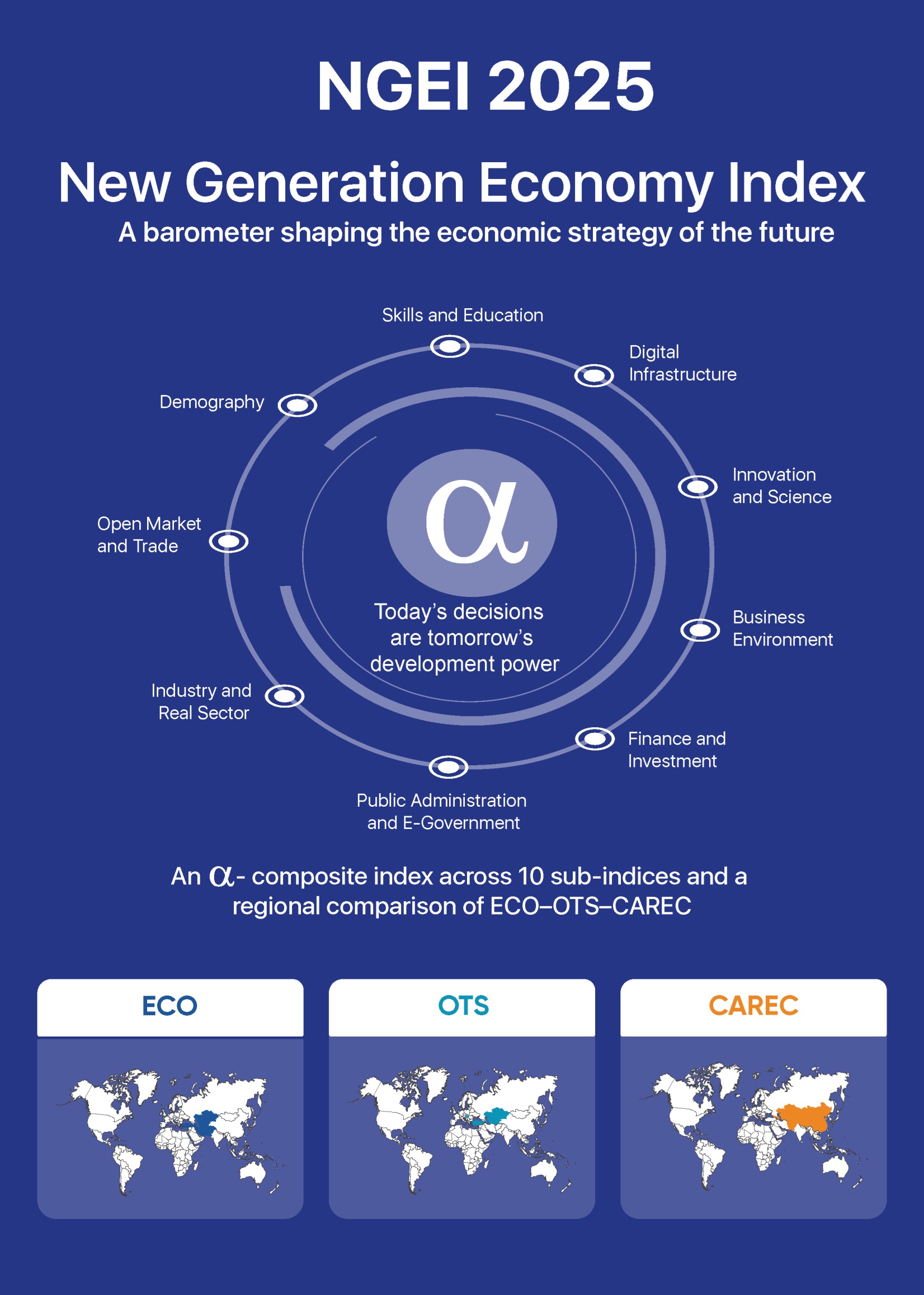
NEW GENERATION ECONOMY INDEX
MAPPING THE NEW ECONOMIC REALITY The New Generation Economy Index 2025 (NGEI) serves as a unique guide to understanding the rapidly evolving landscape of the global economy. Going beyond traditional economic indicators, this publication measures countries’ readiness for the digital future, their innovation potential, and the strength of their human capital. Covering 15 countries, the study reveals both the success formulas of global leaders and the strategic challenges faced by developing economies. “This index is not merely a collection of figures. It is an indispensable compass for governments, business leaders, and the academic community in making strategic decisions”. The book presents a comprehensive comparative analysis of 15 countries belonging to the ECO, OTS, and CAREC organizations, and provides an in-depth discussion of input–output paradoxes as well as strategic roadmaps extending to 2030.
-

FEATURES AND PROBLEMS OF IMPLEMENTING ECONOMIC REFORMS IN AZERBAIJAN
EDITOR-IN-CHIEF

Prof. Dr. Shahin M. Sadigov
Chairman of the Board
Economic Scientific Research Institute of the Ministry of Economy of the Republic of Azerbaijan -
Economic Cooperation Organization Economic Journal
ГЛАВНЫЙ РЕДАКТОР

Профессор д-р Арзу Гусейнова
Первый заместитель председателя совета директоров
ESRI, Азербайджанская РеспубликаВыход последнего номера журнала Экономический журнал ОЭС — знаменательное событие. Исследователи с прогрессивными взглядами внесли свой вклад в журнал, разделив свои взгляды на конкретные темы, которые имеют значение не только на внешнем уровне, но и на глобальном уровне. Такие темы, как конфликты, транспорт, изменение климата, рыночный труд и их влияние на катастрофы, исследуются и анализируются в рамках междисциплинарных исследований с использованием различных методологий для обоснования финансовых решений, оптимизации распределения ресурсов и обеспечения развития. В этом году наблюдается высокий спрос на публикацию журнала «Экономический журнал ОЭС», освещающего важные вопросы. Роль журнала ОЭС следует рассматривать как академическую платформу, на которой исследователи анализируют проблемы и потенциал региона, а также делают выводы и заключения по этим вопросам. Главная задача для редакционной коллегии — побудительное сообщество поделиться своими исследованиями и оставить интерес у читателей. Поэтому необходимо обеспечить содержание журнала на высоком академическом уровне и соответствие мировым стандартам. С другой стороны, оцифровка журнала и разработка его веб-сайта важны для создания более благоприятных условий окружающей среды. В каждом выпуске журнала обсуждается аналитический обзор социально-экономического развития общества, экономических возможностей и достижений государств-членов ВКО, границ с экономическими проблемами и их обществами в Америке. В будущих выпусках журналов мы постараемся добиться нового перелома в отношении более важной для региона темы.
-
NeoEcon review
Frontiers of the New Generation Economy
The journal covers digitalization, green transition, platform & data economy, Industry 5.0, innovation policy, competitiveness, regional integration, regulation & market design, AI/fintech, and data‑driven methods in economic transformation.
We welcome empirical, theoretical, methodological, and data papers.NER publishes high‑quality research on economic transformation at the intersection of digitalization, green transition, platform & data economy, Industry 5.0, innovation and competition policy, regional integration, regulation & market design, AI/fintech, and data‑driven methods. We welcome empirical (experimental and observational), theoretical, methodological, and data papers. Methods include applied econometrics, causal inference, structural modeling, RCTs/natural experiments, network science, text/data mining, bibliometrics, and meta‑analysis.