Vol. 1 No. 1 (2025): NEW GENERATION ECONOMY INDEX METODOLOGY

					View Vol. 1 No. 1 (2025): NEW GENERATION ECONOMY INDEX METODOLOGY

Intorduction
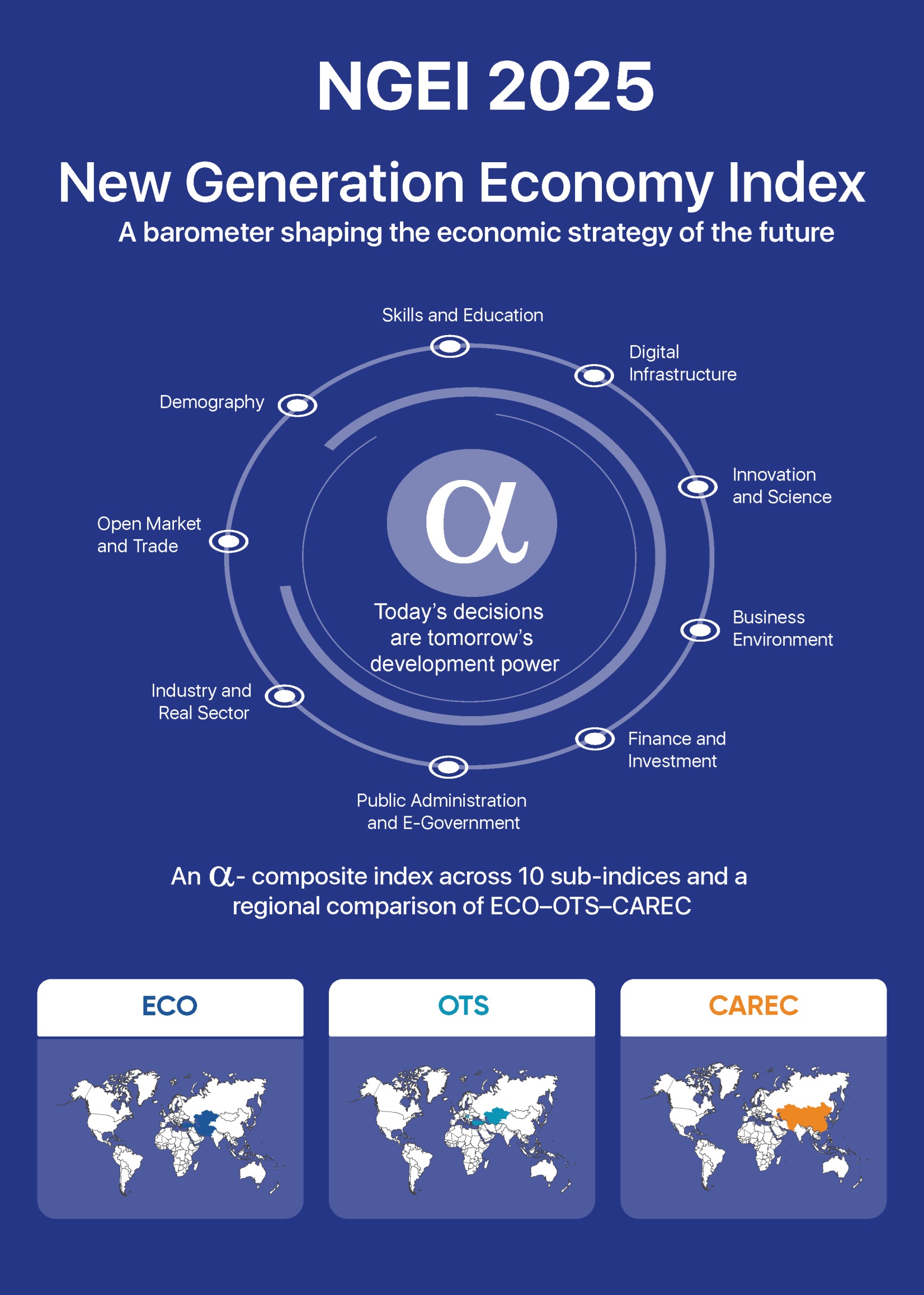
The New Generation Economy Index (NGEI) is a composite set of indicators designed to measure countries’ level of preparedness and adap-tation to the contemporary economic chal-lenges of the 21st century. The primary ob-jective of the Index is to provide an inte-grated assessment of the quality, sustaina-bility, and structural alignment of national economic development with the require-ments of the “new generation” economy. Through this Index, governments and re-searchers can identify countries’ strengths and weaknesses and formulate policy pri-orities on a more solid analytical basis. The significance of the Index lies in the fact that it complements traditional measures (such as GDP per capita) by in-corporating a broader spectrum of devel-opment indicators. As the global economy becomes increasingly based on knowledge, technology, and human capi-tal, ensuring national competitiveness and societal well-being requires attention not only to economic growth rates but also to factors such as skill levels, the innovation ecosystem, infrastructure quality, health, and related dimensions. The NGEI is de-signed precisely to capture these modern dimensions within a unified analytical framework and to provide a comprehen-sive assessment of countries’ capacity to adapt to new economic trends, thereby promoting a multidimensional approach to development. 
Scope: The NGEI is intended to cover as many countries as possible at the global level, including developed, developing, and emerging market economies. Its meth-odology relies on international data sources (such as the World Bank, the United Nations, the OECD, and the World Economic Forum), as well as global sur-veys, which ensure the objectivity and cross-country comparability of assess-ments. The Index can be updated on an an-nual basis and used to monitor trends over time. The results can also be presented at a level of detail sufficient for application in both cross-regional and country-specific policy analyses.


Published: 2026-02-04